
Sodium-cooled Fast Reactors or: How I Learned to Stop Worrying and Love Nuclear Energy
Written in 2019, this essay serves as a call-to-action to save the nuclear power industry.

November 20th, 2019
There’s no easy way to say this, but nuclear energy is the safest source of energy available.
I know we all binge-watched HBO’s Chernobyl this summer and this seems like some sort of Soviet propaganda statement, but it’s true, and nuclear energy is only getting safer.
First off, let’s look at the numbers. According to Forbes.com’s James Conca—an environmental scientist of 33 years—coal kills, on a global average, 100,000 people per trillion-kilowatt hours. Nuclear energy, including the deaths at Fukushima Daiichi and Chernobyl, kills 90.1 At a global annual consumption of 113,009 terrawatt hours, that is 11.3 million people dying from coal, and 10,171 from nuclear per year on average.
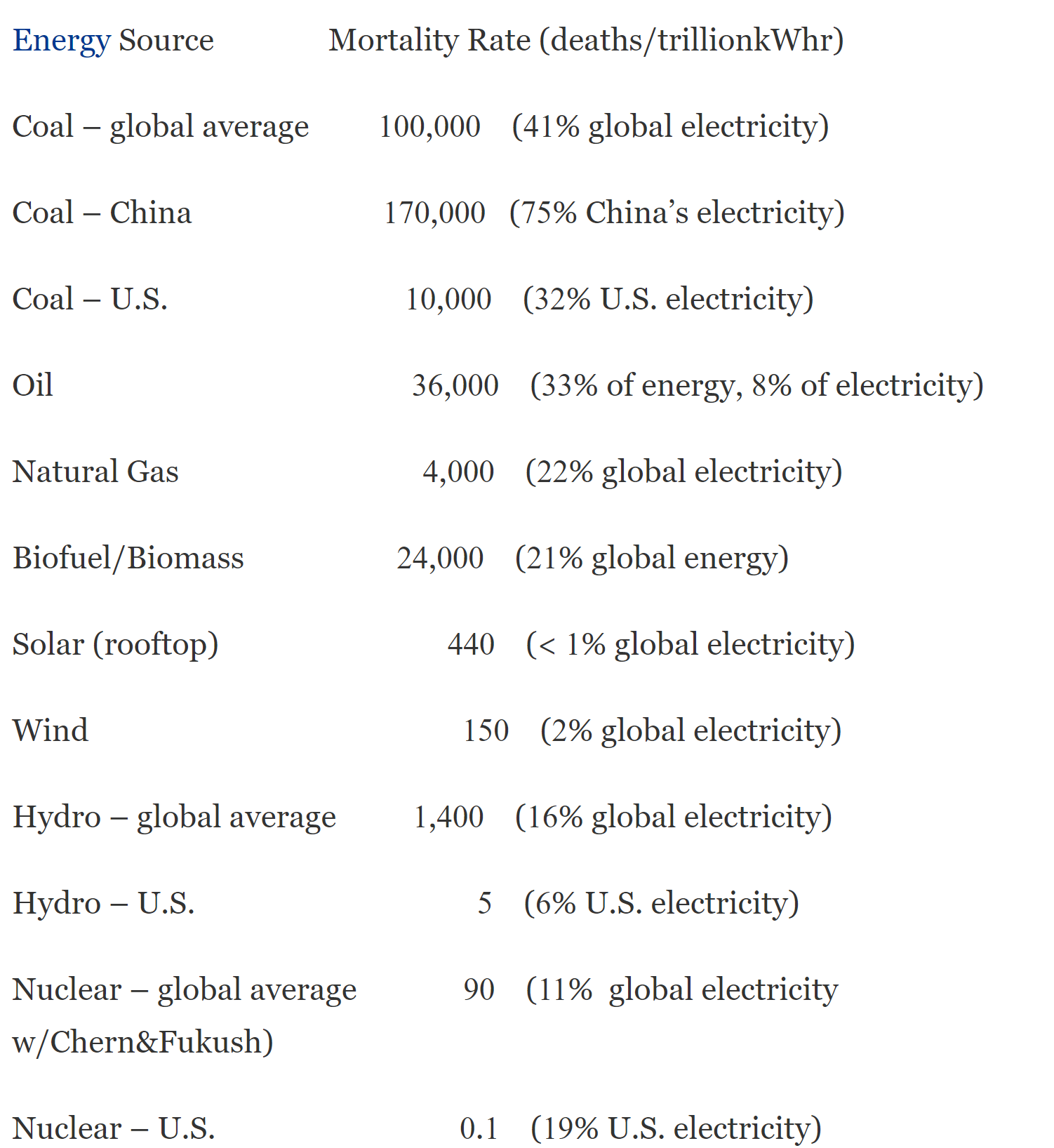
Nuclear has historically and consistently held the lowest deathprint of all major energy sources, including hydro, wind, and solar.2 And while the current numbers are great, we may soon be able to completely erase its deathprint with Generation IV sodium-cooled fast reactors (SFRs).
SFRs are one of the six reactor designs chosen by the Generation IV International Forum (GIF) for further research and development, and the most promising of the lot. GIF, launched in 2000 by the United States and consisting of 13 member countries including France, China, Russia, Japan, and Great Britain, chose SFRs out of nearly 100 reactor designs—and for good reason, as it is one of several designs that can actually use nuclear waste as fuel.3 It would take several hours to go through all the different types of reactors being commercially used, so let’s just say this: the majority use uranium as fuel, and this fuel is single-use. Most reactor designs use this fuel inefficiently, leaving us with literal tons of nuclear waste. Thanks to the halting of deep geological repositories such as WIPP and Yucca Mountain, this waste is stored on-site at your friendly neighborhood nuclear power plant, and we are running out of space rapidly. This is where the SFR comes into play, as it can use this waste in the form of a uranium-plutonium alloy known as MOX (mixed oxide) fuel. The use of MOX fuel reduces our stockpiles of waste, reduces the amount of weapons-grade plutonium, and reduces the energy usage and health costs linked to uranium mining.4
Sodium-cooled fast reactors would, in a perfect world, be able to replace all previous generations of reactors, including boiling water reactors, pressurized water reactors, and graphite-moderated reactors, which were responsible for the Fukushima Daiichi disaster, the Three Mile Island accident, and the Chernobyl disaster respectively. Since SFRs use a closed circuit of non-corrosive, unpressurized coolant with a high heat capacity, many of the safety issues faced by these traditional reactors—and by extension, many of these disasters—are literally impossible.5 Some of these liquid metal-cooled reactors are what is known as breeder reactors, which actually produce fuel, essentially becoming self-sufficient and ending the need for most mining operations.
So, what’s the catch?
The biggest flaw of an SFR is the fact that sodium is highly reactive with both air and water. A leak in the coolant system would create sodium oxide and hydrogen, and hydrogen burns when in contact with air, triggering a series of explosions and sodium fires. Fermi 1, an experimental sodium-cooled fast breeder reactor built near Detroit, experienced a partial meltdown and subsequent explosion in 1966, though it should be noted there were no injuries or radionucleotides released, and that this reactor was built decades before the launch of the GIF.6 SFRs are also quite expensive, with the largest one, France’s Superphénix, costing about $10 billion USD.7 Superphénix was a pre-GIF prototype however, so like Fermi 1, it doesn’t really represent Generation IV SFRs.
If we’re really serious about global climate change, then we really need to get serious about nuclear energy. While wind, solar, and other forms of renewable energy are meritorious in their own right, they aren’t ready to save the planet from impending doom. Wind turbines often function at around 30% capacity due to the unreliable nature of wind, and solar panels utilize photovoltaic cells that are manufactured by pollution-heavy processes (these cells are also not recyclable).8 Both forms also struggle to store energy and send it across long distances. Nuclear, therefore, is our stopgap, and especially SFRs.
With all the world choking on smog or drowning in rising sea levels, it’s hard to overstate the value of both older Gen. II and III reactors and the new Gen. IV designs. China loses about 1.6 million people a year to premature deaths caused by photochemical smog, which comes directly from coal power plants, car exhausts, and factories.9, 10 These deaths aren’t just plant workers, either—they’re children, the elderly, the unlucky…the innocent bystanders. Renewing our nuclear programs internationally—even with boiling water reactors—would save millions of lives, by why settle for an older technology?
The answer to that question is cost. As we saw in Chernobyl, even nuclear power can’t escape the clutches of the almighty dollar, and cost cuts can be deadly (RBMK reactors were equipped with cheap, graphite-tipped control rods. This graphite is what caused the initial explosion at Unit 4). But what is the cost of human life? Can we justify using older reactors that carry a higher danger potential to save a few dollars? We shouldn’t. We should be pushing for newer, safer, faster reactors, like SFRs.
Culturally, we are no longer accepting of nuclear energy in any form. Highly publicized events (that are often dramatized and severely misunderstood) have all but ruined the public’s confidence in nuclear power. In fact, we fear it. We’re scared of our skin sloughing off, our eyes bleeding, our insides liquifying from some unseen particle. But we need to try. We need to look at nuclear with fresh eyes. We need to do what we can. Whether that’s saving old reactors like Perry and Davis-Besse—which power the majority of Northern Ohio and faced closure due to bankruptcy until the passing of House Bill 6 in July of 2019—or building new reactors, the truth is that we are out of time to save our planet. With SFRs, we can finally have a healthy relationship with nuclear energy, but it needs to start soon.
There’s a line from Star Trek: The Original Series that goes “risk, risk is our business!” and I cannot think of something more fitting for nuclear energy. Risk is our business. We risked sending men to the moon, we risk our lives every time we get in a car, we take risks with every decision and move we make. It’s part of who we are. Therefore, we need to take this risk and save the nuclear power industry, if only because it’s what humans do.
We will not save the world by sitting idly by.
1.Conca, James. “How Deadly Is Your Kilowatt? We Rank the Killer Energy Sources.” Forbes, Forbes
Magazine, 10 June 2012, https://www.forbes.com/sites/jamesconca/2012/06/10/energys-deathprint-a-price-always-paid/#5792295c709b.
2. “It Goes Completely against What Most Believe, but out of All Major Energy Sources, Nuclear Is the
Safest.” Our World in Data, https://ourworldindata.org/what-is-the-safest-form-of-energy.
3. “Can Sodium Save Nuclear Power?” Scientific American, 13 Oct. 2014,
https://www.scientificamerican.com/article/can-sodium-save-nuclear-power/.
4. “Military Warheads as a Source of Nuclear Fuel.” World Nuclear Association, World Nuclear
Association, Feb. 2017, https://www.world-nuclear.org/information-library/nuclear-fuel-
cycle/uranium-resources/military-warheads-as-a-source-of-nuclear-fuel.aspx.
5. Rojas, Arturo. Sodium-Cooled Fast Reactors as a Generation IV Nuclear Reactor. Stanford University,
25 May 2018, http://large.stanford.edu/courses/2018/ph241/rojas1/.
6. Fleming, Boomer. The Nuclear Plant Outage of Fermi Unit 1. Stanford University, 7 Mar. 2018,
http://large.stanford.edu/courses/2018/ph241/fleming1/.
7. Abdul-Kafi, Salahodeen. The Superphénix Fast-Breeder Reactor. Stanford University, 30 Mar. 2011,
http://large.stanford.edu/courses/2011/ph241/abdul-kafi1/.
8. Rinkesh. “7 Pros and Cons of Wind Energy.” Conserve Energy Future, 3 Feb. 2017,
https://www.conserve-energy-future.com/pros-and-cons-of-wind-energy.php.
9. Stanway, David. “China Cuts Smog but Health Damage Already Done: Study.” Reuters, Thomson
Reuters, 18 Apr. 2018, https://www.reuters.com/article/us-china-pollution-health/china-cuts-smog-but-health-damage-already-done-study-idUSKBN1HO0C4.
10. National Geographic Society. “Smog.” National Geographic Society, 9 Oct. 2012,
https://www.nationalgeographic.org/encyclopedia/smog/.